Aberfan 60 Years On: 1 in 10 Welsh households live near ‘high risk’ coal tips, at risk from climate change
Sixty years on from the Aberfan disaster, when the collapse of a coal tip onto took the lives of 116 children and 28 adults, one in 10 Welsh households live within 1km of a high-risk coal tip, research by Round Our Way found.
An estimated 135,653 households live within 1km of the 368 sites officially rated Category C or D, meaning they pose a potential risk to public safety and need inspection yearly.
The most dangerous coal tip sites are concentrated in South Wales. Rhondda Cynon Taf alone has 85 Category C or D sites. Merthyr Tydfil has 60. Caerphilly, Bridgend and Neath Port Talbot each have more than 40 high-risk tips, all in communities that have already faced decades of post-industrial hardship and a lack of investment.
With tens of thousands of Welsh households still living in the shadow of potentially dangerous coal tips and the increase in extreme weather and heavy rain due to climate change there are increasing fears about the safety of the tips that still exist, with slips happening during Storm Bert in 2024 and Storm Dennis in 2020.
A coal tip slip in 2024, after weeks of heavy rain
Ralph Connor and Tina Honeyfield, who live in Cwmtillery, a former coal-mining town in the South Wales valleys, experienced what happens when a tip slipped down a hillside above their home in November 2024 after weeks of heavy rain.
Ralph said: “Luckily it was just the edge of the tip that came down. If [the main tip] had come down, we wouldn’t be speaking with you today. We are just one community and there are thousands of these tips around Wales. After Aberfan happened, you would have expected for them all to be dealt with so that could never happen again, but it hasn’t.
“If nothing is done about climate change, communities like this - the poorest communities - are always going to be the ones that suffer the most. We are going to have more devastating floods and more landslides if people and governments don’t start thinking in a long-term way.”
Insurance market uncertainty a ‘canary in the coaltip’ for climate change impacts in Wales
Round Our Way gathered 420 building insurance quotes for homes near Wales' most at-risk tips, the 368 sites officially rated Category C or D.
The analysis of quotes for homes within 1km of a dangerous tip found households being offered prices well above the national average and wide differences between quotes for the same home in the same area.
The Welsh Government has recognised that climate change has a role to play in the ongoing risk the tips pose to the public. “In February 2020, the impact of climate change saw increased winter storms with extreme rainfall. This caused a landslip at a disused coal tip in Tylorstown, Rhondda Cynon Taf.”
Sofie Jenkinson, Co-Director of Round Our Way, an organisation that supports people impacted by climate change in the UK, said:
"Wales powered the industrial revolution but people are still living with the consequences. Half of the UK's coal tips are in Wales and 350 of them are high risk. In recent years, as the weather has started to change, there has been growing concerns about their safety.
“Not only are these coal tips putting people at risk but they are increases costs in these communities. Our analysis has found that people living in these areas pay 40% above the Welsh median to ensure their homes.
“The Welsh Government are working hard to manage the worst of the risks to people’s safety. However, what we are seeing here is a ‘canary in the coal tip’, indicating how increasing extreme weather is putting people's lives at risk and impacting everyday costs. We need to see more political action to put the legacy of the last industrial revolution right, make sure a disaster like Aberfan never happens again and ensures that the next energy revolution improves the lives of people and communities in Wales."
‘Invisible’ market withdrawal
The research found that households within 1 km of a high-risk tip can expect to pay 40% more for buildings insurance compared to the Welsh median.
Insurers disagreed more about how to price insurance for homes near coal tips. For the same property, the most expensive insurer typically quoted 64% more than the cheapest, a gap of about £104 a year. For similar homes further from a tip, the gap was 46%, or about £88. The range of prices across all homes near tips was also wider: £161 between the cheapest and dearest quarter of quotes, against £141 for homes further away.
Withdrawing cheapest offers
Whilst few insurers in the survey refused to offer a quote, there was evidence that cheaper insurance policies were being removed for some properties near to dangerous coal tips.
Most insurers offered three policy options for each home, from cheapest to most expensive. But in 30 of 387 quotes for homes near tips, the insurer withheld its cheapest option. Direct Line withdrew its Home Essentials product in 18 of 154 quotes, a rate of 12%, and Churchill did the same in 12 of 142. Admiral never did. In a further 33 cases, 8% of attempts, insurers refused to quote at all, and seven homes could not get a quote from any insurer tried.
The Met Office has calculated that the decade 2015–2024 has been 2% wetter than 1991–2020 and 10% wetter than 1961 to 1990, meanwhile every one degree of global warming is projected to cause a 7% increase in extreme daily rainfall, according to the World Meteorological Organization. The winter in 2025/2026 in the UK, was the wettest on record for some parts of the UK, according to the Met Office.
The UK’s Climate Change Committee, an independent statutory body set up to advise local and national governments, recently warned that Britain is not prepared for the impact of climate change.
A climate crisis made visible
The 2,589 coal tips scattered across Wales are a physical legacy of the fossil fuel extraction that occurred during the industrial era, but they are becoming a climate crisis in real time. When Storm Dennis battered South Wales in February 2020, extreme rainfall triggered a landslip at a disused tip in Tylorstown, Rhondda Cynon Taf, bringing the danger into living rooms across the country. Scientists warn that more intense and frequent storms will make flooding make such events more likely.
The most dangerous coal tip sites are concentrated in South Wales. Rhondda Cynon Taf alone has 85 Category C or D sites. Merthyr Tydfil has 60. Caerphilly, Bridgend and Neath Port Talbot each have more than 40 high-risk tips, all in communities that have already faced decades of post-industrial hardship and a lack of investment.
Gemma Plumb, a Meteorologist from Weather Change, said: “We are seeing more intense rainfall now because of climate change, and this brings an increased risk of flooding.
“A warmer atmosphere can hold more moisture and this means that when it rains, it now rains more. The UK's climate has become steadily wetter since the 1980s, and this is due to an increase in the winter 'half-year' rainfall, the rainfall that falls between October to March.”
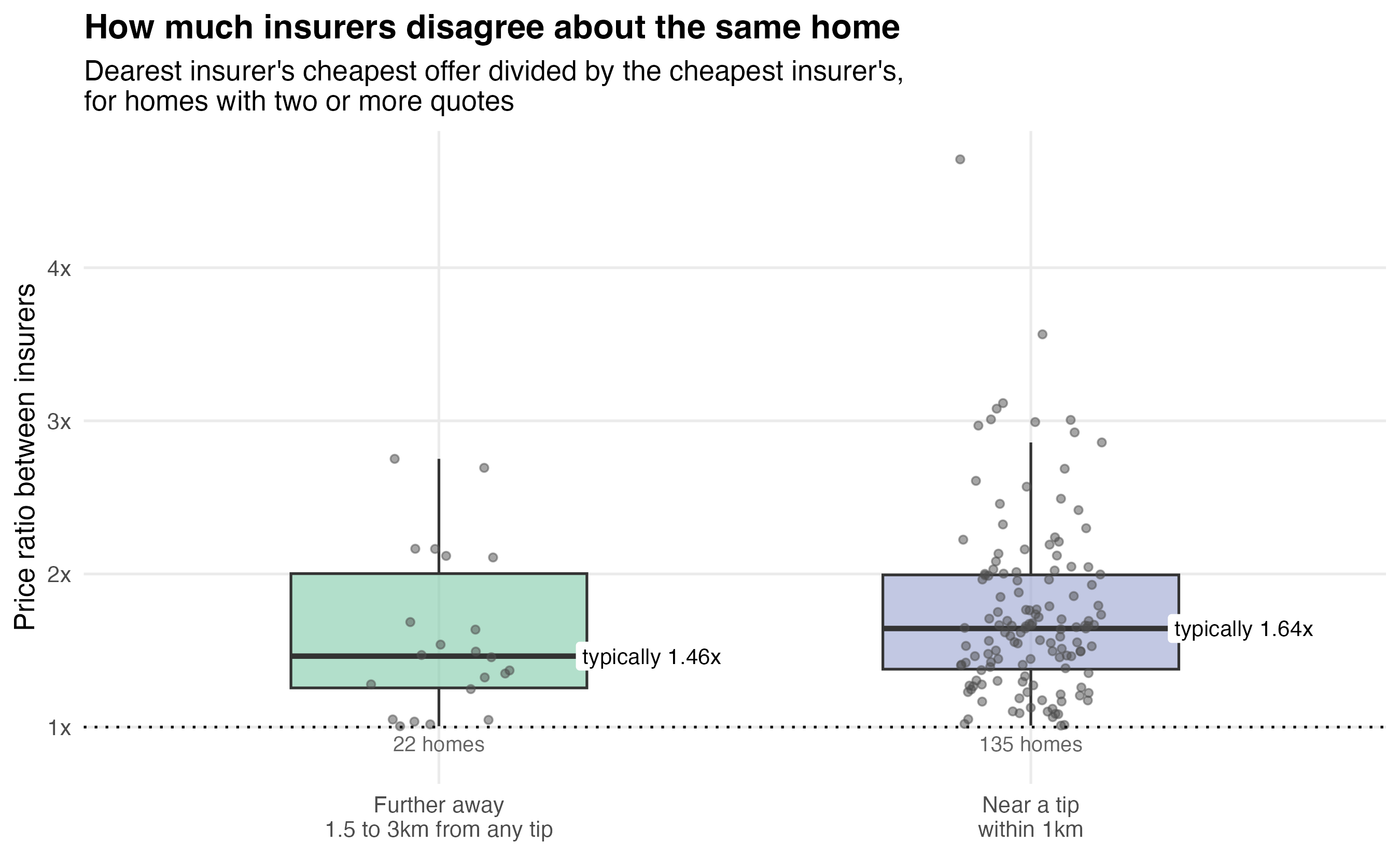
Wide variation in prices quoted could be an early sign that the insurance market is struggling to price risk for homes nearby coal tips
Topics: Floods